
A simple lesson from nature
Biomimicry sounds like a complicated idea, but it rests on a simple observation: nature already knows how to do most of what we are trying to engineer. Watch any animal, ourselves included, and you will notice that food is always bitten and broken down before it is digested. The mouth does the physical work so the gut can do the chemical work.
Composting follows the same principle. Before microbes can break down organic waste, the waste has to be broken down physically. Smaller pieces mean more surface area, more bacterial contact, and faster decomposition.
This matters especially in aerobic composting systems like ours, where no special microbial cultures are added. The work is done entirely by the bacteria already present in kitchen and garden waste, and they need help getting started.
That help is shredding.
Is shredding always necessary?
For almost every composting setup, yes. What changes is the tool, not the principle. Depending on the volume and type of waste, shredding can be done with:
- A kitchen knife — for a single household
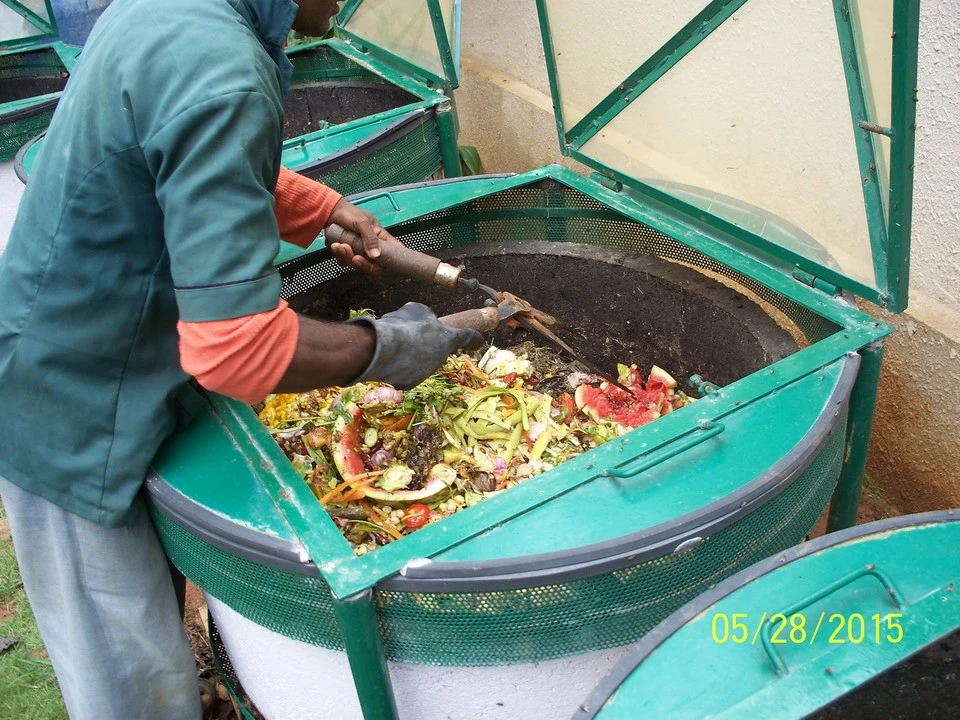
- A pair of garden shears — for a small community
- A powered shredder, such as our Model 8B2H — for larger residential or commercial volumes
The only real exception is a commercial canteen or party hall with no kitchen, where the waste is purely plate waste — already cooked, soft, and small enough to compost as is. Everywhere else, some form of size reduction is needed.
Five factors that decide the right shredding method
1. Composition of waste
Waste profiles vary more than people expect.
A residential complex with extensive landscaping generates large quantities of yard waste: falling leaves, hedge trimmings, grass cuttings, fallen flowers, and the occasional branch. A high-rise with minimal greenery generates almost none of this and produces mostly kitchen and plate waste. Office canteens with active kitchens add a steady stream of fruit and vegetable peels and stalks.
And as food delivery becomes a daily habit in Indian cities, we are seeing more cooked food being thrown away than ever before. Each of these waste profiles has different shredding needs.
2. Volume of waste
Across several hundred homes we have assessed in Bangalore, a reliable working estimate is:
1.2 litres or about 800 grams of wet waste per home per day.
Outliers exist on both sides, but this number is a good starting point when site-specific data is not available. Once you know the daily volume, you can decide whether manual shredding will hold up or whether a powered system is the better answer.
3. Available manpower
A short clip we recorded shows waste being chopped manually with garden shears, ready for composting: watch the manual shredding demo.
One operator can comfortably handle 30 to 40 kg of waste a day, which works out to roughly 30 households. For larger communities, more operators are needed.
A simple thumb rule we suggest:
One man-hour for every 50 homes.
Build in some redundancy beyond this for leave and backup.
4. Budget
Manual tools are inexpensive but labour-dependent. Powered shredders require capital up front but reduce ongoing effort. The right answer depends on where a community would rather spend — on people or on equipment.
5. Carbon footprint
This factor deserves a closer look, because it is often misunderstood.
Rethinking the carbon footprint of a powered shredder
Every daily choice has a carbon cost. Cycling to work is cleaner than driving, but whether it is feasible depends on distance and context. The same logic applies to shredding.
Here is the part worth sitting with: by the time food becomes waste, an enormous amount of energy has already been spent on it. Cold storage. Transport. Cooking. Reheating. Refrigeration of leftovers. Composting sits at the very end of this chain.
Our Model 8B2H power shredder consumes about 1.5 to 2 units of electricity to process the daily waste of 100 homes. Set that against the energy already spent feeding those 100 homes, and the number is small.
Avoiding a power shredder purely on energy grounds — while ignoring the rest of the food chain — misses the bigger picture. The right approach is to minimise power use where we can, and apply it where it genuinely improves the outcome.
What to look for in a power shredder
When we set out to design our own shredder, we studied what was already available and found two recurring problems.
Some shredders reduce waste to a pulp or puree. This makes aerobic composting harder, not easier. A wet, dense mass cannot be turned and aerated properly. Aerobic composting needs structure, not slurry.
Others use high-speed blades built for dry agricultural or yard waste. These do a poor job on wet kitchen waste, splattering it outward and creating a mess that has to be cleaned up before composting can even begin.
How the Model 8B2H is different
The Model 8B2H was built to address both problems:
- Operates at low speed, suitable for wet kitchen waste
- Handles garden waste, kitchen waste, and harder organic matter like bones and shells
- Reduces waste to about one centimetre in size — ideal for aerobic decomposition
- Top-loading hopper for safe, simple operation
See it in action: watch the 8B2H shredding green plant material.
Note: green garden waste is harder to shred than dry brown waste, so for stout stalks and branches we recommend letting them dry first.
The takeaway
Shredding is not an optional refinement in composting. It is what makes the process efficient in both time and space, and it is often the difference between compost that takes weeks and compost that takes months.
The tool you choose — a knife, a pair of shears, or a powered shredder — should follow from the waste you generate, the people you have, the budget you can commit, and an honest reading of the carbon cost across the full food chain, not just the last step.
Compost well, and the rest of the system takes care of itself.
Looking for the right composting setup for your community?
Whether you are managing waste for a single home, an apartment complex, or a commercial site, we can help you choose the system that fits.
[Explore Marigold composting solutions →] [Talk to our team →]