
Marigold is Bangalore’s trusted home composter for families, apartment residents and gated communities.
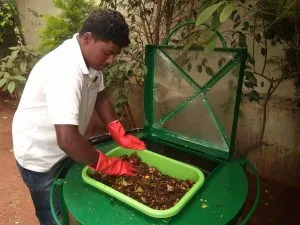
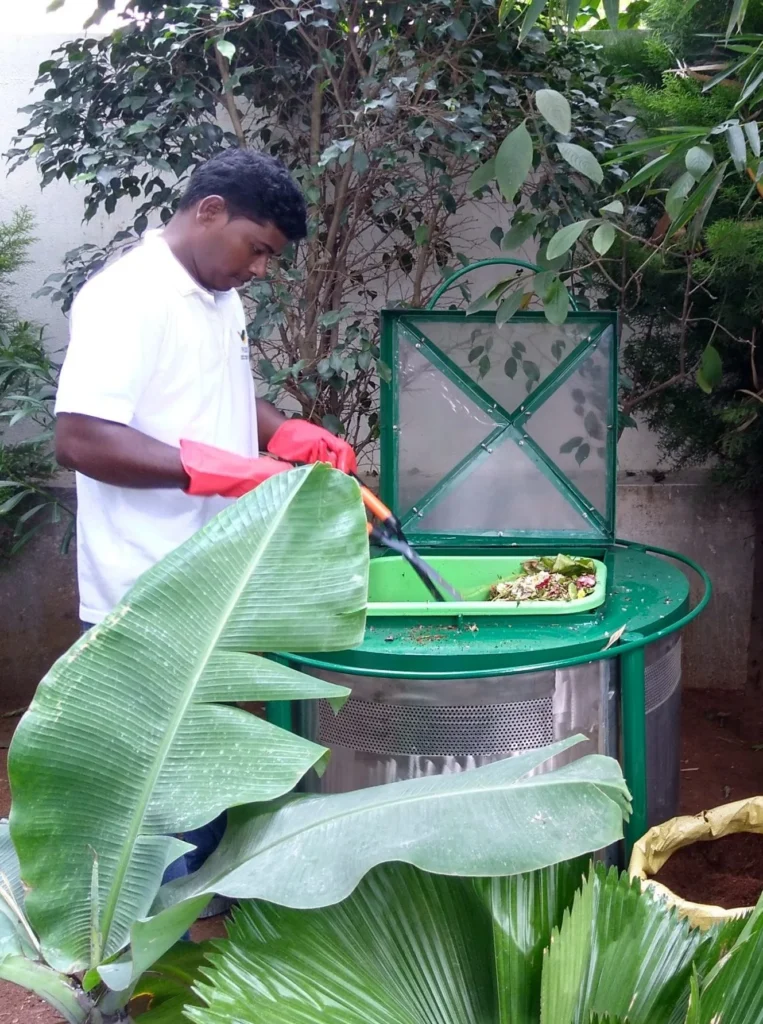
Our composting systems are designed for natural, odor-free aerobic composting of kitchen and organic waste – ideal for homes, apartments, gated communities, and shared spaces.
The process relies on natural convection of air balanced with thermal insulation, moisture retention, and natural microbes already present in organic waste, transforming it into nutrient-rich compost in as little as 10–12 days of active composting, followed by a short curing period.
Unlike many composting systems, Marigold does not require special proprietary additives, enzymes, or forced heating, keeping the composting cycle safe, sustainable, and truly natural.
From compact balcony setups to industrial scale community hubs, Marigold scales with your commitment.
Manage food waste where it’s generated and reduce waste collection costs.
Odour-controlled design suitable for apartments and shared spaces.
No electricity, naturally aerobic composting process.
From 1 kg/day home composting to 500+ kg/day community systems.
Secure enclosed construction ensures clean, safe, rodent and fly proof composting.
Fits balconies, terraces, utility spaces and small community areas with ease.
Composts naturally – no enzymes, starters, or synthetic accelerators required.
Approx. 12-day active composting plus natural curing for nutrient-rich compost.
Step 1 – Add Kitchen Waste Shred or chop your daily kitchen scraps before dropping them into the composter. Vegetable peels, fruit waste, cooked food – all goes in.
Step 2 – Mix for 5 Minutes Once a day, give it a quick mix with help of a low cost garden fork.
Step 3 – Let Nature Do the Work The aerobic process takes over. Natural microbes break down the waste. No smell. No electricity.
Step 4 – Harvest Rich Compost In 30 to 35 days your kitchen waste becomes nutrient-rich compost for your garden or plants.
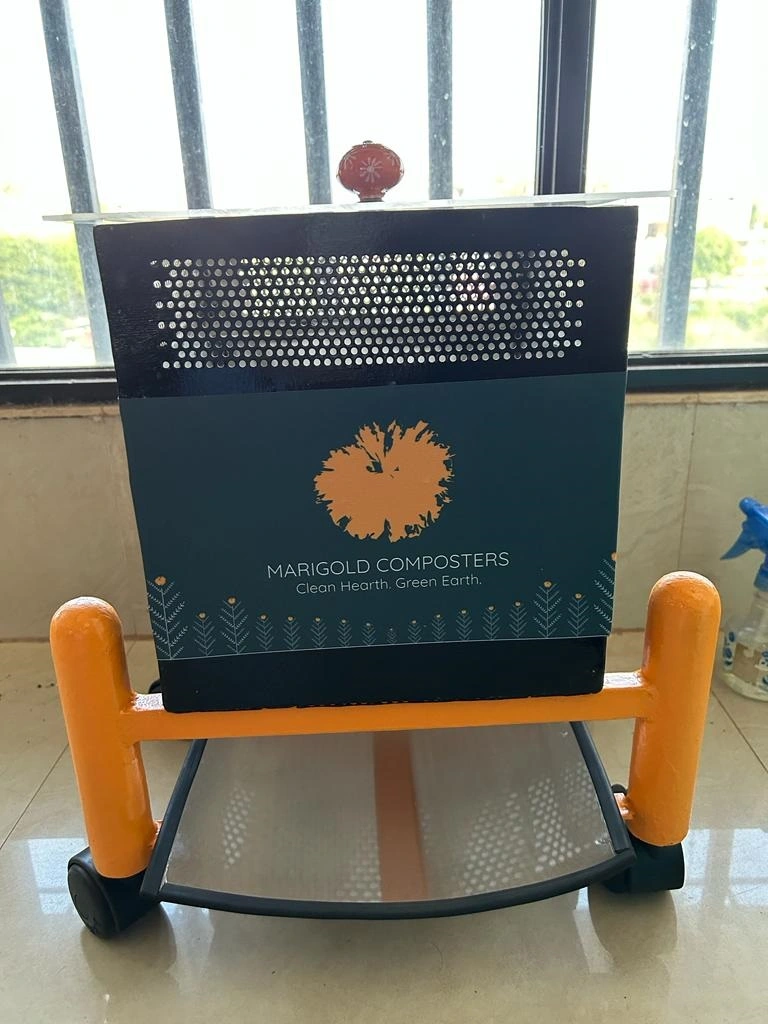
This eco-friendly home composting kit helps you manage daily kitchen waste easily and odor-free. Turn food scraps into nutrient-rich compost — perfect for apartments, balconies, and small homes. Get started right away!
DESIGN TYPE: Compact, Odor-free Aerobic Bin, Made of Stainless Steel
PLACEMENT: Balcony, Utility Area, or Kitchen
CAPACITY: 10 Lit (0.5 kg/day, 1–2 members). Floor space: 38cm x 30cm (16 inches x 12 inches).
DELIVERY / SHIPPING: 3 to 4 weeks (within Bangalore)
Note: Delivery charges will be calculated and provided later.
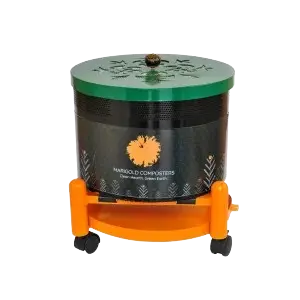
This eco-friendly home composting kit helps you manage daily kitchen waste easily and odor-free. Turn food scraps into nutrient-rich compost — perfect for apartments, balconies, and small homes. Get started right away!
DESIGN TYPE: Compact, Odor-free Aerobic Bin, Made of Stainless Steel
PLACEMENT: Balcony, Utility Area, or Kitchen
CAPACITY: 20 Lit (1 kg/day, 2–3 members). Floor space: 45cm x 45cm (18 inches x 18 inches).
DELIVERY / SHIPPING: 3 to 4 weeks (within Bangalore)
Note: Delivery charges will be calculated and provided later.
This eco-friendly home composting kit helps you manage daily kitchen waste easily and odor-free. Turn food scraps into nutrient-rich compost — perfect for apartments, balconies, and small homes. Get started right away!
DESIGN TYPE: Compact, Odor-free Aerobic Bin, Made of Stainless Steel
PLACEMENT: Balcony, Utility Area, or Kitchen
CAPACITY: 40 Lit (2 kg/day, for larger families). Floor space: 55cm x 55cm (22 inches x 22 inches).
DELIVERY / SHIPPING: 3 to 4 weeks (within Bangalore)
Note: Delivery charges will be calculated and provided later.
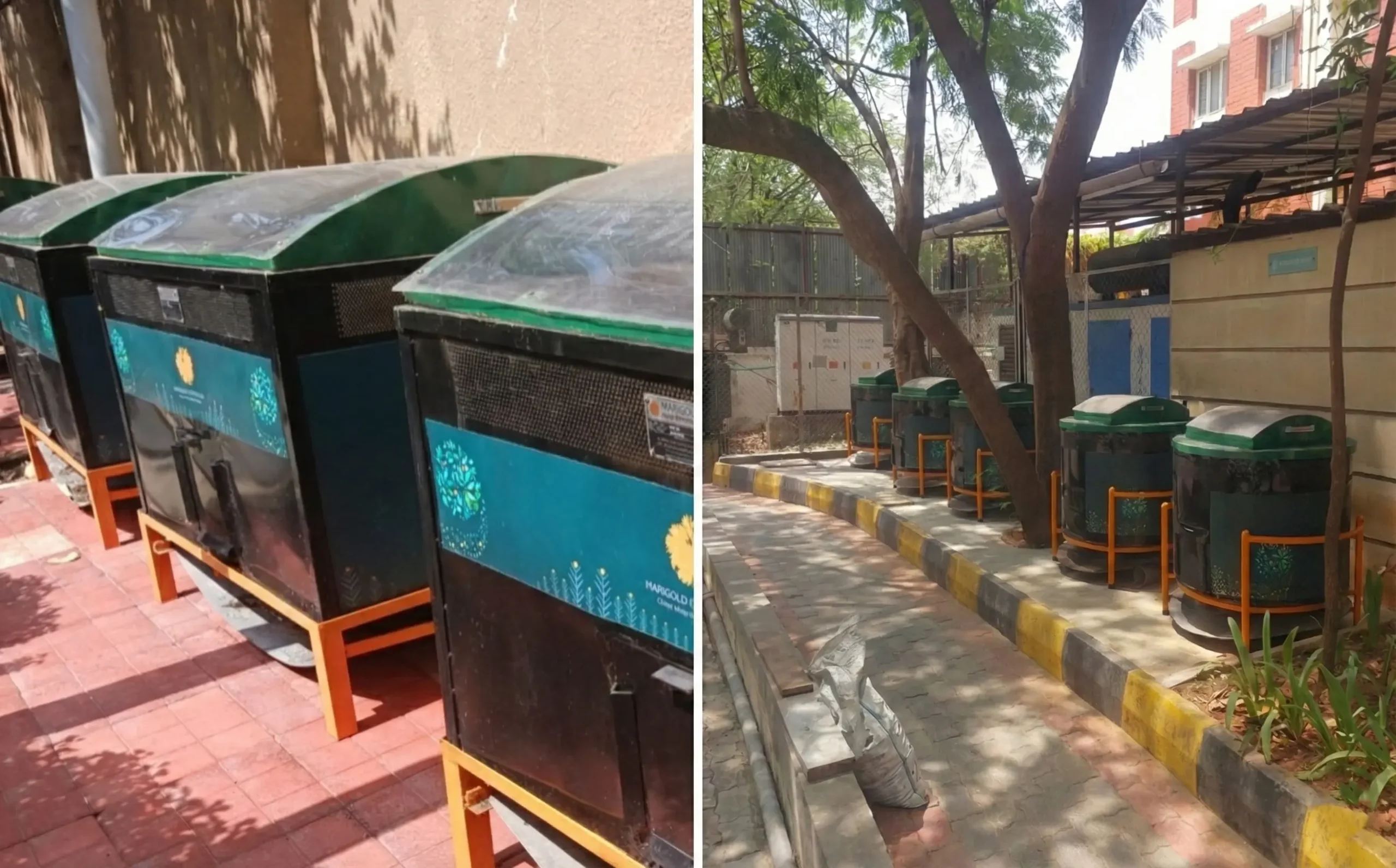
Sustainable waste management for communities of every size. Ideal for residential societies, gated communities, restaurants, schools, and commercial kitchens. Reduce waste collection costs, eliminate landfill dumping, and create organic compost for in-house landscaping and gardens.
BUILD MATERIAL: Stainless steel build
INSTALLATION: Outdoor installation (no sheds needed)
CAPACITY: 20 kg/day capacity per unit
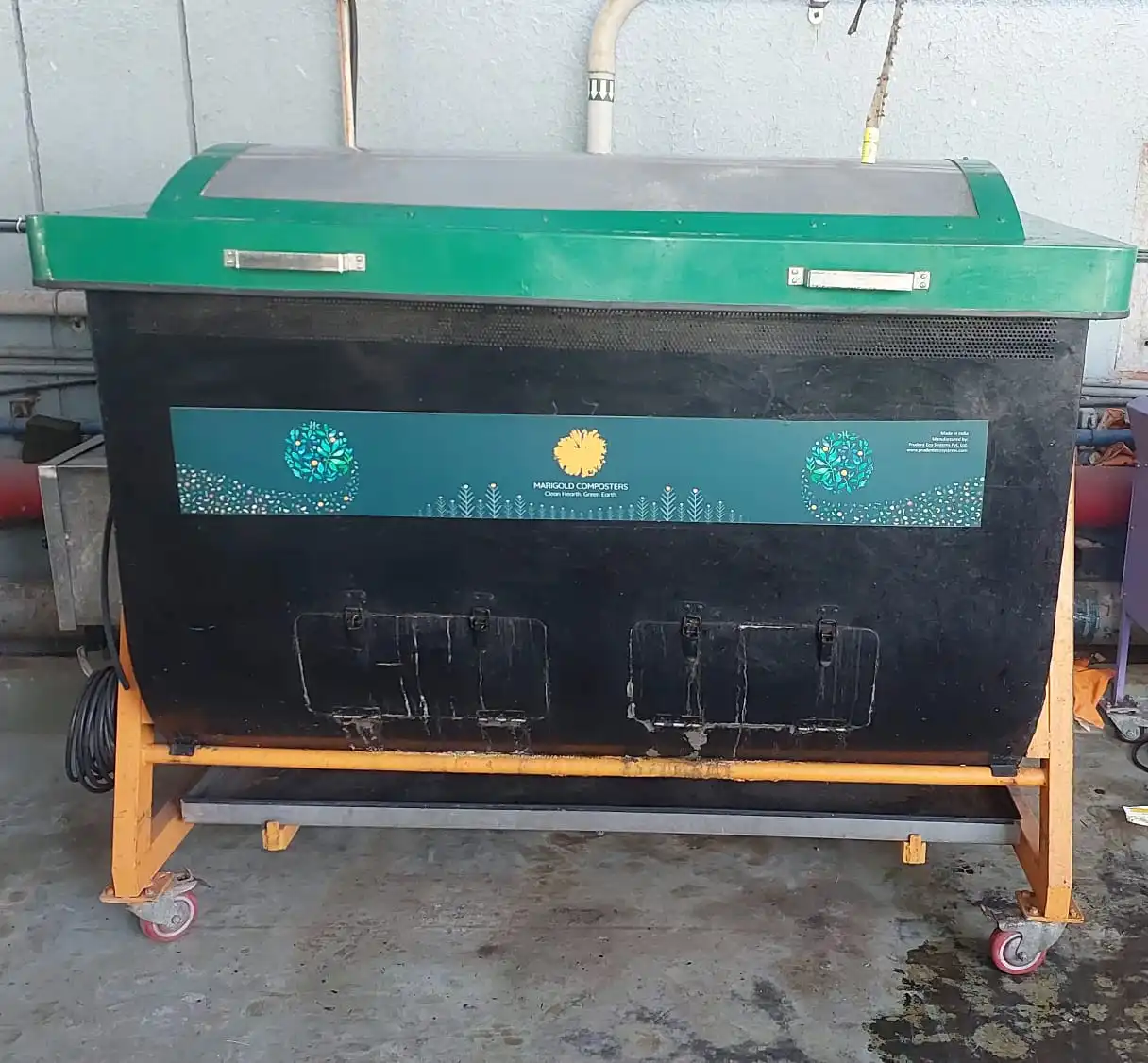
Mixing being an essential part of the composting process can be automated by having an integrated mixer. A mere 5 minutes a day is enough to keep the aerobic process going well and consumes a negligible amount of electricity. The MXL model can take a single load of 400 kg or a daily feed of 40 kg/day.
EFFORTLESS OPERATION: Integrated mixer automates the process
POWER EFFICIENCY: Negligible power consumption (3-5 min/day)
MODEL MXL CAPACITY: 400 kg load or 40 kg/day feed
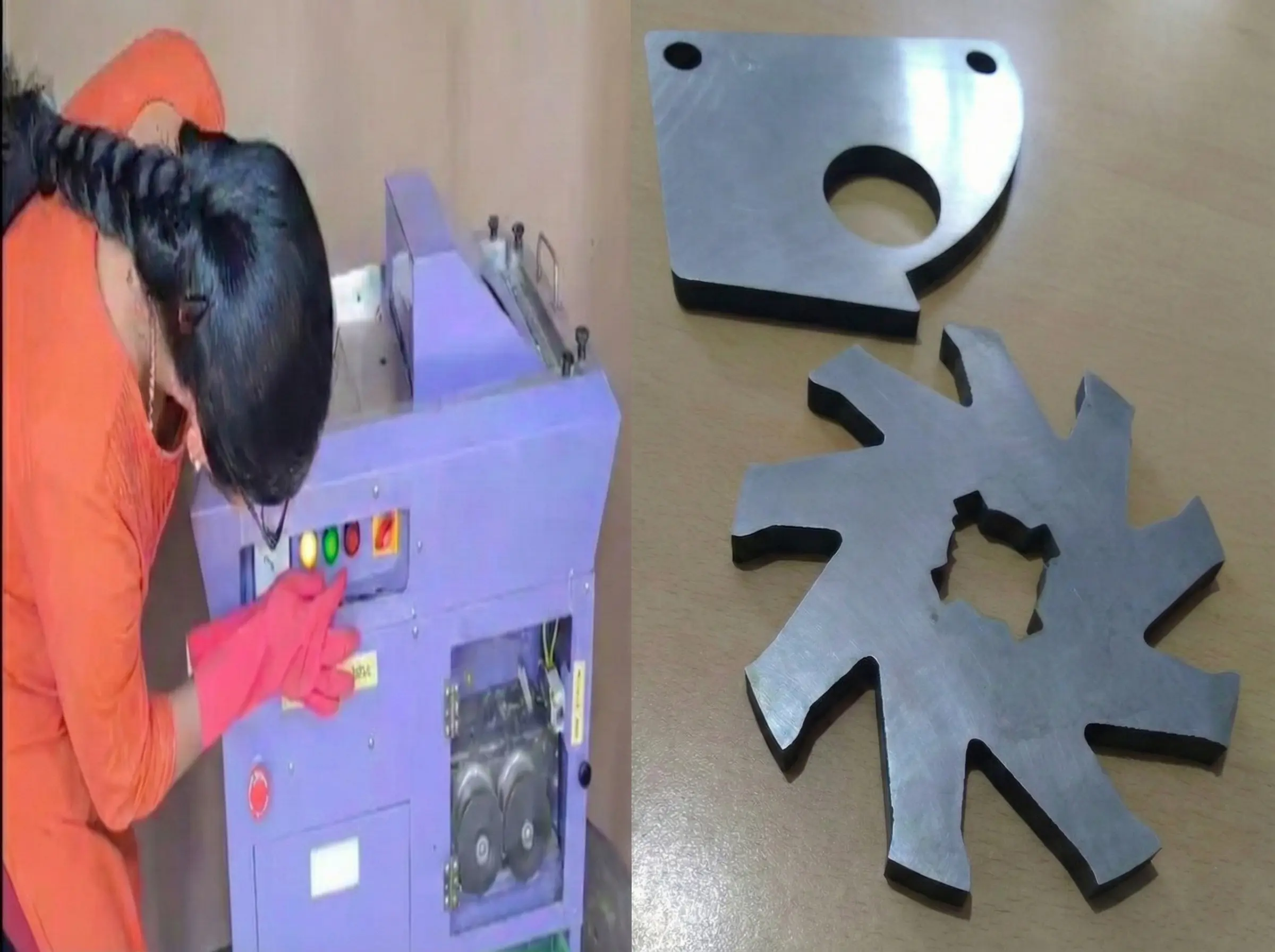
Shredding of wet waste is the essential first step in composting (and bio gas generation). Prudent Eco System waste shredder is a low noise shredder making it ideal for residential areas. The noise is barely audible some meters away. Its rugged shredding blades are made of stainless steel.
APPLICATION: Essential first step for composting & biogas
NOISE LEVEL: Low noise, ideal for residential environments
DURABILITY: Rugged stainless steel blades
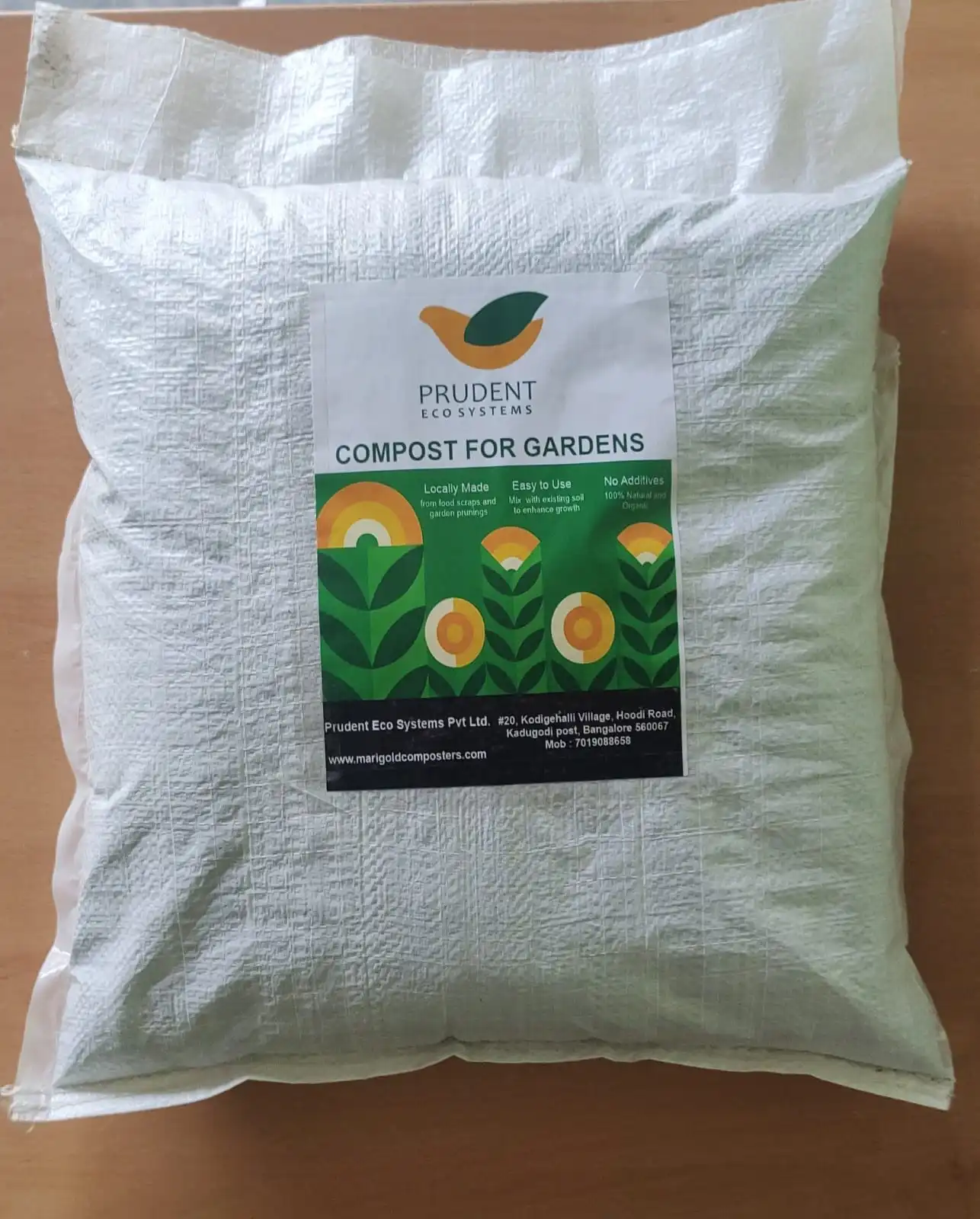
Grown from your kitchen. Given back to your garden. Prepared from domestic kitchen waste through a strictly natural aerobic process — no chemical additives, no artificial heating. Completely matured, pathogen-free, and ready to enrich the soil of any urban garden.
PROCESS: Strictly natural aerobic composting — no artificial heating, no chemical additives
QUALITY: Thermophilic composting (above 50°C) destroys plant pathogens. Completely matured.
HOW TO USE: Mix in equal proportion (1:1:1) with soil and cocopeat, or add directly to top soil of existing plants
PACK SIZE: 5 kg per bag — ideally suited for urban gardens and balcony plants
Note: Delivery charges will be calculated and provided later.
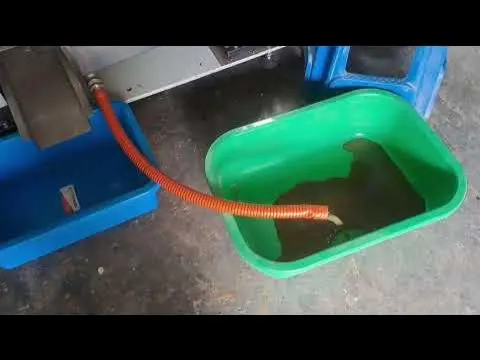
A dewatering screw press mechanically squeezes excess moisture out of food waste before it goes into the composting process. Removing water upfront reduces the weight and volume of waste that needs handling, cuts down on odour and effluent, and helps the composting cycle that follows run faster and more efficiently.
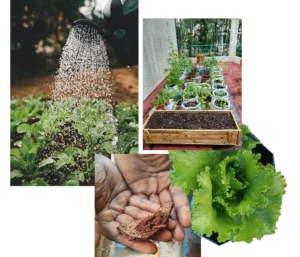
Earth’s natural systems are regenerative by design.
When organic kitchen waste goes to landfills, we lose a valuable resource and increase methane emissions.
We believe in a future where every household and community composts at source, turning food scraps into living soil that nourishes our farms, gardens, and planet.
Together, we can build zero-waste homes and circular communities that support life on Earth.
150+
Total Marigold Composter Installations
36
Customer Sites
3200 kgs
Total Waste Capacity per day


















Real stories from our community of composters. Verified Google Reviews.

Lakshmi Prasad
9 reviews
Verified
Google Review
"Excellent product and great service! 6 years ago we bought their solar metal composter bins for our kitchen wet waste. With just simple 2 steps, we have been composting and preparing organic manure for our home garden every 2 months. Thanks team Prudent!"
Ramya B S
Local Guide · 9 reviews
Verified
Google Review
"It's been over five fruitful months of composting kitchen waste in our little community of 19 families with our pretty Marigold Composter. The composter has been a breeze to manage, with no stench, flies or infestations. We've so far harvested over 65 kgs of black gold."
Gagan Lumba
7 reviews
Verified
Google Review
"I am writing this review after using their product for 4 months. The home composter is a perfect fit for a small family. The best thing is that there is no plastic used in the product. It takes me just 5 minutes every day to complete the process. It is a good buy for anyone interested in home composting."
Loved your Marigold composter? Your review helps families and communities make the right choice.
Rate Us on GoogleIn-depth answers on composting science, system design, and our process.
Observing the waste generation pattern across several apartments in Bangalore, the most common number we see is an average of 0.8 kg per home per day. This is an average figure in an apartment complex, some homes will have very little, some much more, and some flats may be vacant.
A cycle time of 12 days has been observed for any month of the year and over a four-year period in Bangalore. In warmer months, we have observed a cycle time of less than 12 days; however, for capacity calculations, we use 12 days. This period is also called the "in-vessel" time, where the material needs to be mixed daily and most of the composting action takes place.
We observe a sharp rise in core temperature to more than 50°C and often crossing 65°C. This phase (thermophilic phase) lasts a few days and then temperature gradually drops to a few degrees above the ambient temperature. Most of the composting would be done, and the rest can happen in the curing bag/container over a further period of 20 days. This (curing) is a passive phase and no stirring or mixing is needed.
If the composters are getting filled in less than 12 days, then additional capacity is needed.
As an example, if you have 4 composters, each of 180 litres, then the daily fill rate should be less than 60 litres/day (un-shredded volume equivalent of 40 kg/day).
It is difficult to generalise and be accurate since the type of waste varies a lot. However, if we take a non-homogenous quantity (which is typical when considering waste from several homes), we have observed that wet waste has a density of about 0.6 kg/litre.
For monthly estimates, we recommend purchasing 30% by weight. So, if an apartment generates an average of 35 kg/day, the cocopeat requirement will be 7.5 kg/day or 225 kg/month.
When purchasing cocopeat, you will notice that the cost of the cocopeat is much lower than the cost to transport it to your premises. Hence it is good to purchase as much as can be carried in one trip of the van, provided storage space is not a problem.
In the above example, 225 kg would be 9 bags. If we purchase 1,000 kg (a typical full load for a small van), then we would need to buy 40 bags or about 4 months supply.
Both leaf powder and cocopeat serve the purpose of supplying carbon to the microbes in the composting process. In addition, both help to absorb extra moisture and any odour also. In either case, it is important to ensure that cocopeat / leaf powder is dry.
Sawdust is obtained from the processing of wood which has been treated with chemicals like formaldehyde known to kill bacteria and micro-organisms which are essential to composting. The presence of such chemicals will prevent composting action and give rise to a very strong stench which cannot be controlled.
The differences arise from a few practical issues, summarised below:
| Cocopeat | Leaf Powder |
|---|---|
| Being a by-product from coir processing, it has to be sourced from outside the city and has to travel at least 60km to 100km | Is derived from fallen-leaves in parks and apartments within city limits. |
| Homogenous | Heterogenous as it is a blend from the leaves of several trees. |
| Neutral in terms of smell | Can impart an aroma – especially if leaves from trees like Eucalyptus are used. |
| Usually transported as compressed blocks which are wetted to expand. Hence cocopeat is often damp (which is not desirable from composting point of view) | This is powdered at site from a large collection of leaves and is always stored in dried condition. |
| Availability – right through the year | Seasonal and needs to be stocked. |
| Only one or two major suppliers in the city and they can control the availability & price | 1. Dry leaves are available from BBMP parks, apartments and communities. 2. Anyone can make their own leaf powder either by purchasing a shredder or renting it from Prudent Eco Systems. |
| If the lot is damp, more of cocopeat (in terms of weight) is needed. | Being dry, smaller quantity (in terms of weight) is needed for composting |
While the “in-vessel” time for compost is 12 days, the curing period is about 20 days. If we let the compost rest in a curing container for two cycles, it would be 24 days and is more convenient to estimate the time. Taking into account the shrinkage of compost during the cycle, we recommend having curing containers which are about 1.5 x the volume of a composter. If you have 360 Lit composters, it is convenient to have a curing box with a volume of more than 540 Lit along with each composter.
The reduction in weight of wet waste (after mixing with cocopeat and composting) would be approximately 60% to 70%. If we begin with 100kg of wet waste we would end up with 30kg to 40kg of compost.
Here below is a tabulation for an apartment with 150 homes., showing the full sizing and operating-cost estimate.
| Number of Composters | ||
|---|---|---|
| Parameter | Value | Units |
| No. of homes | 150 | — |
| Composter capacity | 430 | Litres |
| Total wet waste | 120 | kg/day |
| No of Composters | 6 | |
| Cocopeat Requirement & Cost | ||
| Cocopeat requirement | 20% - - 25 kg per day | by weight |
| Compost Output | ||
| Compost generated (approx.) | 30% - 35 | kg/day |
These numbers are estimates and can be manually rounded when preparing a quotation. For a tabulation specific to your community size, please get in touch.
Shredding is a must. For small amounts of waste, hand shredding using garden shears is possible, else powered shredder must be used. Just like animals bite and cut food before swallowing, shredding helps in faster composting by exposing larger surface area to microbial action.
A lot of energy is consumed in the processing of food right till it is served on the table. Purchase (by car/delivery van), Cold storage (till use), cooking, mixing/grinding, heating etc. It is only after all this that we discuss the disposal (or composting) of food in the form of waste. Taking a holistic view, one cannot stop using power to treat waste but surely one must minimise it and use it only where really needed. This is applicable to shredding as well.
Assuming a 200 home apartment generates about 160kg of waste per day, a 1.5HP shredder would consume about 1.1 units per day or just 33 units per month. For 200 homes, this power consumption is negligible.
Aerobic composting, as the name suggests, is a process where we allow air to circulate within the pile of waste. To enable this, we must maintain the following 4 steps:
1. Foremost benefit for residential areas is that no odourous gases are generated. Be sure - If there is odour, then the process has not been followed correctly.
2. It generates internal heat which helps faster composting.
3. The cycle time is much faster. (About 30 days, of which only the first 10 to 15 days will need the waste to be inside the composter, followed by about 20 days of curing / maturation.
It is to be mixed in the ratio of 1:3 by volume: 1 measure of cocopeat for 3 measures of wet waste. We had provided a 10 Lit measuring can which has a mark at the 3.3 Lit level to make this easy. This measurement is to be done with the un-shredded waste. After shredding there will be some reduction in volume. Note that this is only the initial (first-day) addition. More cocopeat or more water may need to be added on the remaining 11 days of the 12 day cycle.
In one sentence: not too wet (soggy), not too dry. Just damp! On the practical side here are some thumb rules which make it easy to follow
As explained above, the aerobic composting process would generate internal heat. In summer, the pile can quickly lose moisture due to internal and external heat. Hence water has to be sprinkled to prevent drying up of the waste. In the monsoons, since the air is humid, the waste will not lose (or lose less) moisture. In addition, there could be some ingress of moisture too due to rain water seeping through any cracks that have developed. This is the season in which we are most likely to see odour issues. Hence the moisture has to be reduced by adding cocopeat (or leaf powder) bit by bit.
Mixing not only keeps all the waste composting at (almost) the same rate but also makes sure there are no lumps, all portions exposed to air for at least a few minutes a day. The bacterial growth will be about the same in all portions. In short , the entire pile would soon become homogenous.
Divide the container into quarters (as viewed from above) and turn over each quarter completely. Go right down to the base of the composter and scrape it clean. Then carve out a cylindrical cavity in the centre and bring turn the waste up and down. This is only to ensure that when drawing out the quarters, no portion in the centre was left un-done.
A perfectly aerobic process will generate no odour, as the resultant gas is CO2 which is odourless. To keep the composting process free of odour – the aim should be to encourage all conditions which help aerobic composting which are
A typical graph of daily temperature log would look something like below. The dotted area shows the intense (thermophilic) composting activity
The shaded green band marks the thermophilic zone (≥50°C), where pathogens and weed seeds are destroyed. Peak temperature observed: 73°C on Day 6.
We differentiate our system from others in the following ways
In the Marigold System – there are two stages: one which is the high temperature stage where the material is left for temperature to rise beyond 50 deg C (sometime even up to 70 0 C) and then fall again to a little over ambient. At this stage the material is moved to the curing box which is the 2nd stage of composting – with no mixing. It is left here for 24 days.
This is done so that the composter (made from stainless steel) can make way for fresh waste. If we were to keep the waste beyond the high temperature period, the investment needed by the customer would increase. Hence after the high temperature stage, it is moved to a low-cost wooden container.
So even in our system, the cycle time (of composting + curing) would be about 36 days. 12 days in the steel composter, 24 days in wooden box.
We have not seen other systems (in the segment where we operate) where high temperature (thermophilic) composting is demonstrated. Those with short cycle times (even 24hrs) use heating. The features in our system which enable this natural rapid rise in temperature
We have observed that due to the fine particle size of cocopeat (or leaf powder – which is even finer) the volumes are not additive. Adding 3 Lit of cocopeat to 10 Lit of wet waste will not increase the volume beyond 10 Lit (maybe very slightly) when it is mixed well. The fine powder gets into the gaps between pieces of shredded waste. In terms of weight, yes of course they will add. But not in terms of volume. [In the earlier years, we used brown leaves and at that time the volume would be additive. Moving to leaf powder or cocopeat not only has the advantage of volume not being additive but the leaf powder coats all portions of the wet waste and almost eliminates the chance of odour.]
Over a complete 12-day cycle, we notice that (just before removing the material for curing) the volume will reduce by about 25% to 30%. So a 360 Lit mass would become around 250 Lit when moved to the curing box. Hence a single curing box of 640 lit is more than sufficient to take 2 cycles of waste from a single composter of 360 Lit.
As mentioned in Q1, there are 2 stages – the active high temperature stage and the passive (curing stage). In our system, as waste (mixed with appropriate amounts of cocopeat) is added to a composter, it is blended with the material from the previous day(s). Hence the waste from day #2 benefits from the microbes and heat generated by day#1. Likewise, if the same composter is fed waste on Day#3, then this waste benefits from the waste of Day#1, Day#2 as well. [So this process is non-linear] Yes, there will be waste (of the last batch) which would not get the full benefit of the double-walled steel vessel and will be transferred to the curing box allowing the balance composting to happen in the curing box where it will be embedded in waste which has seen a full cycle.
We remove the waste when the temperature has risen (above 50 deg C) and fallen (below 40 deg C).
Marigold Composters by Prudent Eco Systems Pvt. Ltd
No 20, Kodigehalli Hoodi Road, K R Puram, Bengaluru, 560067, Karnataka
Phone: +91 70190 88658