
An engineer’s note on soil, waste, and the loop we broke
After a long career in electrical engineering, you might reasonably expect a piece from me on the importance of a good earth, the kind we measure in ohms and bond to a copper rod buried in moist soil. I am going to disappoint that reader. The earth I want to write about today, and the case for kitchen waste composting as part of its repair.
Sixty years is one lifetime
In December 2014, Maria-Helena Semedo of the UN’s Food and Agriculture Organisation gave a warning that should have stopped traffic: the world’s topsoil, she said, could be gone within sixty years at current rates of degradation. Sixty years is not a geological timescale. It is one human lifetime. The principal culprit she named was chemical-heavy farming, the same model of agriculture that fed the post-war population boom and is now eating the ground it stands on.
The same body of research that delivers this warning also points to the way out. Organic farming, returning carbon and biology to the soil rather than only minerals, is the most credible path back to fertile, resilient land. India has taken a measured first step in this direction with the Soil Health Card Scheme, which has shown what many on the ground already suspected: a large number of farmers are over-fertilising, spending more on chemical inputs than their soil actually needs, and degrading the very asset they depend on.
Why this is a city problem
Kitchen waste composting is the simplest way for an urban household to return that organic matter to circulation. This is usually where a city reader closes the tab. Soil is a rural problem, fertilizer is a rural cost, and the conversation belongs to someone else. It does not. A large share of the organic matter that should be going back to Indian soil is sitting in our urban kitchens, and most of it is being sent to a landfill where it will rot anaerobically and release methane instead of nutrients.
What the lab results tell us
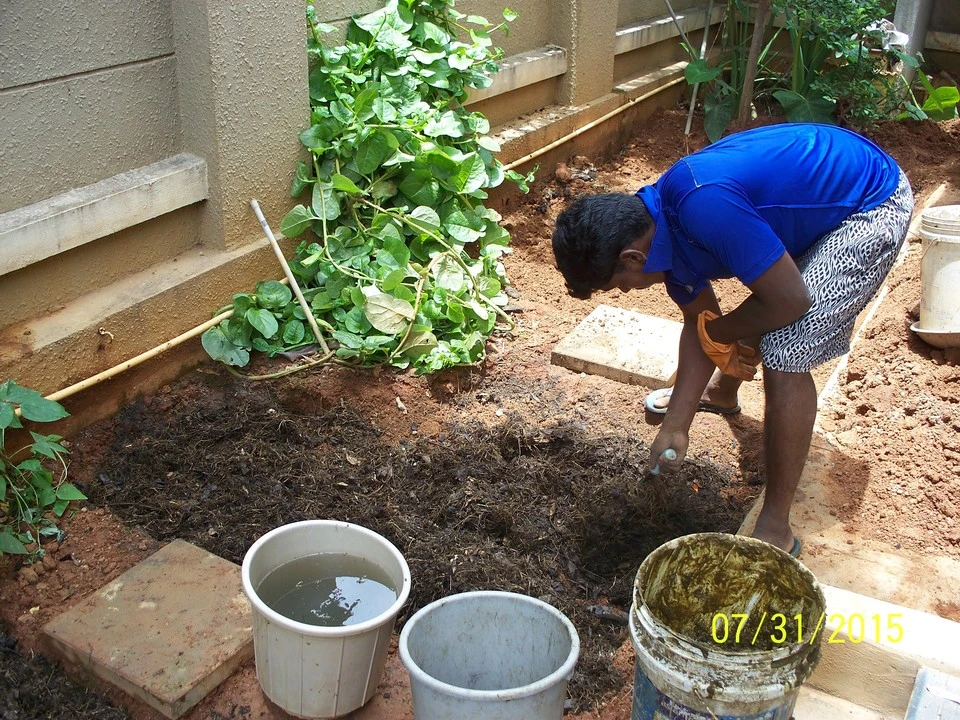
This is the part of the kitchen waste composting story Prudent Eco Systems has spent years working on. Our work with apartments and industrial canteens across Bangalore has shown that kitchen waste, composted on site using passive aerobic technology, without additives, without inoculants, without machinery that needs a service contract, produces compost that holds up under laboratory scrutiny.
Samples drawn from three apartment communities and two industrial canteens were tested at certified labs. On the principal parameters that define an organic fertilizer, nitrogen, phosphorus, potassium, organic carbon, and the C:N ratio, the results consistently met or exceeded the minimum limits prescribed for organic fertilizer. This is not compost as a gardening hobby. This is compost as an agricultural input.
The number that matters
The implication is worth sitting with. A gated community of two hundred apartments generates enough wet waste in a year to produce several tonnes of finished compost. Aggregated across a city, the number becomes significant. Aggregated across India’s urban population, it becomes a quiet answer to a loud problem. Multiply that by the number of communities now adopting kitchen waste composting, and the city-scale arithmetic becomes hard to ignore. The waste that municipal corporations are paying to transport and bury is the same material a degraded farm is paying to replace with a sack of urea.
The missing piece is not technology
The technology exists, is affordable, and is already running in dozens of locations. The missing piece is the channel. Compost generated in cities needs to be processed to a consistent grade and moved back to the farms that need it, closing a loop that industrial agriculture broke about sixty years ago. That is the work ahead, and it is more logistical than scientific.
Where a city resident begins
For the city resident, the entry point is smaller and more immediate. Kitchen waste composting at source removes the longest, most expensive leg of the waste chain in one decision. Segregate wet waste at source. Ask your apartment association what happens to it after the bin. If the answer is the landfill, there is a better answer available, and it does not require a pilot project or a government grant to start.
Soil is not a renewable resource on any timescale that matters to us. It is built slowly, by biology, from the residues of what once lived. The kitchen is the one place in the modern city where that biology is still showing up every day, in a bucket, waiting to be put back where it belongs.
As for the reader who came here hoping to learn about the other kind of good earth, the one with a resistance value and a fault current rating, I will not leave you empty-handed. The IEEE Green Book remains an excellent reference.