
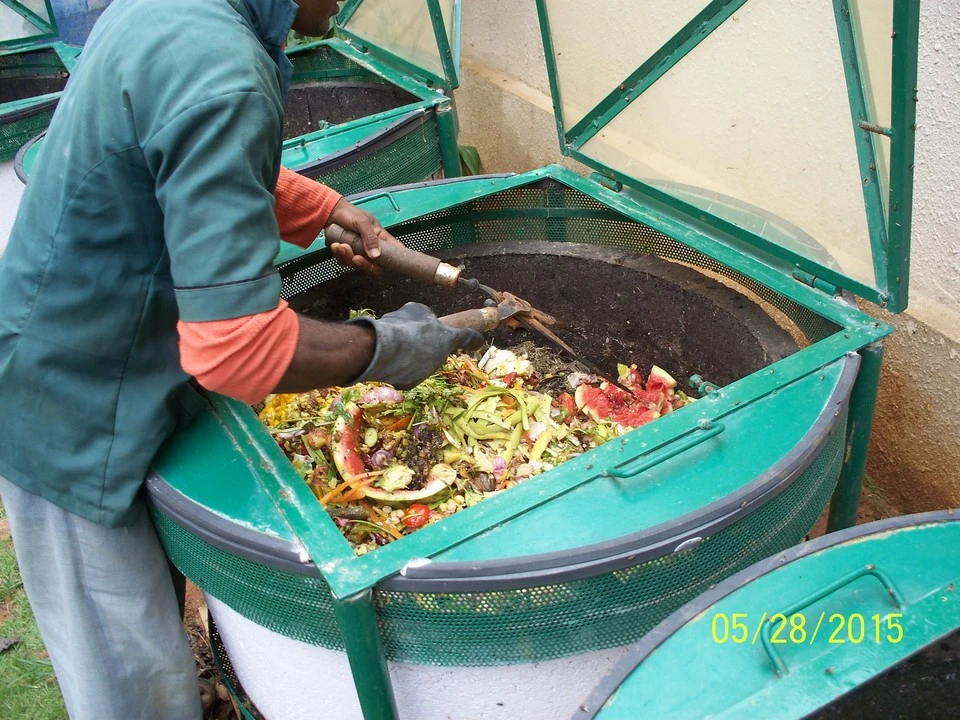
Composting at home is no longer a hobbyist choice for urban Indian families. It is becoming a civic necessity. Indian cities are growing faster in population than in area, and the civic systems built decades ago are now being asked to handle volumes of waste they were never designed for. The familiar model — collecting mixed waste at the doorstep and trucking it to a centralized facility or a distant dumping ground — is quietly running out of room.
This needs to change, and the reasons are not complicated.
What actually sits inside a landfill
Most household waste is a mixture. Food scraps, packaging, paper, plastic, the occasional battery, sanitary waste, garden trimmings. Once these are dumped together and left to break down in the open, two things happen.
The first is leaching. Rain water filters through the heap, picks up chemicals, and carries them into the soil and the groundwater table. From there, those compounds find their way back into the food chain, eventually returning to the same households that produced the waste in the first place.
The second is uncontrolled decomposition. Organic waste buried under layers of dry waste breaks down without oxygen, releasing methane and other gases that contribute directly to global warming. A landfill is not a passive storage site. It is an active emitter.
The math is uncomfortable
Take an average urban household. Roughly one kilogram of waste a day, split fairly evenly between wet kitchen waste and dry waste. That works out to about 365 kg of waste per home per year travelling to a landfill.
Multiply that across a city of a few million households and the scale of the problem becomes obvious. This is not a minor inconvenience for the municipal corporation. It is a structural challenge that the existing infrastructure cannot keep pace with.
Why segregation is the first step
Consider a small thought experiment. Take three useful things from your kitchen: salt, sugar, and soap. Now mix them. In a few seconds, you have turned three valuable items into one unusable mixture.
Household waste behaves the same way.
Wet waste, on its own, is a resource. It can be composted into organic manure that rebuilds soil. Dry waste, on its own, is also a resource. Paper, metal, and clean plastic can be recycled into new products, which reduces fresh demand on natural materials. Mix the two, and both lose their value almost immediately.
Segregation at source is not a civic instruction. It is the single decision that determines whether your waste becomes a resource or a pollutant. This idea sits at the heart of our approach to urban waste at Marigold.
What composting at home actually saves
If a household composts its wet waste on-site, that 365 kg per year does not enter the municipal stream. It does not need a truck to carry it. It does not contribute to fuel consumption, traffic, or the emissions that come with both. It does not add to the load at the dumping ground.
Instead, it stays at home as nutrient-rich compost that can be used in balcony gardens, society landscaping, or shared with anyone growing plants nearby. Marigold’s on-site composting solutions are built precisely for this, designed to fit homes, apartments, and gated communities without odour or maintenance hassle.
The shift is small at the household level and significant at the city level.
Why composting at home matters more than ever?
So far, composting has been framed here as a solution to an urban waste problem. The wider view is more serious.
Research suggests that the planet has roughly 60 years of usable topsoil left at current rates of degradation. Without topsoil, agriculture and horticulture as we know them become extremely difficult. In this interview, Professor John Crawford explains the issue clearly, and points to the single most effective remedy: returning carbon to the soil.
This is precisely what composting at home achieves. Along with carbon, it carries nitrogen, phosphates, potassium, and a living population of microbes that healthy soil depends on. It also reduces the reliance on chemical fertilisers, which over time strip soil of the very structure that makes it productive.
Composting at home, then, is not only about clearing the kitchen bin. It is a small, steady contribution to the soil that everything we eat eventually depends on.
What comes next
In the next article in this series, we will look at how to actually start composting at home, the methods that work in apartments and gated communities, and how to set up a system that runs without odour, pests, or constant attention.
The first step, though, is the one each of us can take today. Segregate. Keep wet waste separate. Treat it as a resource, not a problem to be moved elsewhere.
That is where every meaningful change in how a city handles its waste begins. Composting at home is the first step every urban family can take, starting today.