
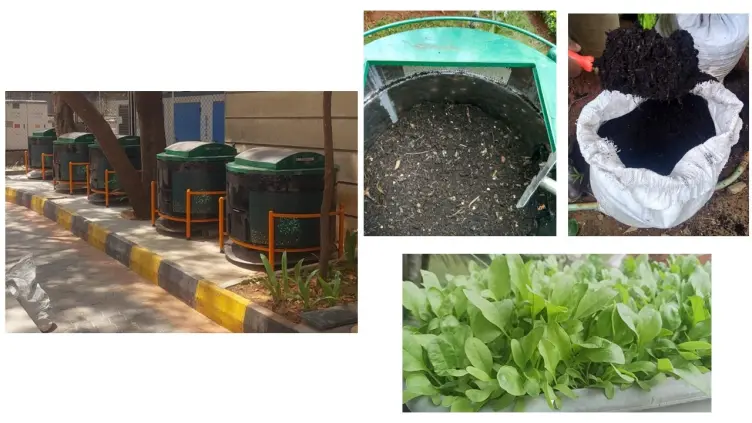
Why composting matters isn’t obvious until you look at what happens when we don’t do it. Composting itself isn’t difficult, but it does ask for some planning and sustained effort, the same way cleanliness or exercise does. If you haven’t composted before, it helps to understand exactly why it matters. That understanding is what keeps the habit going once the initial motivation fades.
The Hygiene Problem Nobody Wants to Own
A pile of rubbish is an eyesore at best. Add wet, decomposing food waste to it, and it becomes something nobody wants near their home. If that waste isn’t processed at the source, it typically ends up in a landfill, creating a nuisance for someone else, including the villages that lie along the route to the dumping ground and in its shadow. It’s a small but concrete illustration of why composting matters at the household level, long before you get to the larger environmental case.
The Pollution Cost of Centralized Waste
As Indian cities grow, civic authorities are increasingly stretched to manage the sheer volume of solid waste. A modest city of 2 million people has roughly 500,000 families, and generates close to 400 metric tonnes of waste every single day. For India’s larger metros, that figure multiplies several times over.
In big cities, it isn’t just the volume that grows. The distance to a dumping or processing site grows with it too, sometimes stretching to 50 km. That means hundreds, even thousands, of tonnes of waste travelling through city streets daily. More diesel trucks on the road. More traffic congestion. More pollution once it reaches the dumping ground. This is exactly why composting matters more in dense urban environments than anywhere else: it removes waste from that entire chain before it begins.
Bangalore’s Municipal Corporation captured the alternative in a simple slogan: “namma kasa namma javabdhari,” our waste is our responsibility. Composting is what makes that responsibility practical. It lets households and communities manage their own wet waste on-site, instead of waiting for civic infrastructure to catch up.
Untreated solid waste is rarely just food scraps. It’s usually a heterogeneous mix of plastic, rubber, foam, glass, and metal, all exposed to sun and rain. This combination leaches chemicals into the ground, which eventually reach groundwater and the food chain. Uncontrolled decomposition also releases methane, a gas that accelerates global warming far more aggressively than CO2. That’s part of why waste dumps occasionally catch fire, and why some sewage-laden lakes have been seen with flames on their surface.
Indore offers a working counter-example. The city’s Gobar Dhan bio-CNG plant processes hundreds of tonnes of segregated waste daily to fuel its public buses, turning what was once a liability into usable fuel.
Waste Reduction Starts With Personal Responsibility
Examples like Indore remain rare, because the further waste travels from the point of generation, the more its cost and complexity of processing increases, often to unmanageable levels. When we take personal responsibility for processing our own waste, even a few times a week, the sheer scale of what we were discarding becomes hard to ignore, and it’s often the clearest personal proof of why composting matters more than any statistic can show.
What Composting Does for Soil Health
Destruction is almost always faster than construction, and nowhere is this truer than with topsoil, the few inches of earth that sustain all agriculture. In roughly 150 years of industrialisation, the planet has lost more than half its topsoil. What took nature millennia to build has been eroded in under two centuries, and current projections suggest we could lose the remainder within the next 60 years if practices don’t change.
Chemical-intensive farming is a major contributor. As soil fertility declines, farmers apply more fertiliser to maintain yield, a cycle that further depletes the soil. Compost interrupts this cycle on several fronts. It holds moisture and improves water infiltration, which reduces erosion. It reintroduces nutrients the soil has lost. And it restores beneficial microbes while giving earthworms a safe habitat, something chemical fertiliser can’t do. The UN FAO’s research on soil organic matter lays out these benefits in detail, and it’s a useful reference for anyone who wants the underlying science.
Composting and Carbon Sequestration
The water cycle, evaporation, cloud formation, rainfall, is intuitive to most people. The carbon cycle is just as critical, though far less understood. Plants convert atmospheric CO2 into biomass: fruit, vegetables, grains. Living beings consume this, exhale CO2, and discharge the rest as waste. Forests, in turn, help pull CO2 back out of the atmosphere.
Over the last two centuries, two human activities have disrupted this cycle at scale: the rapid burning of fossil fuels, and the large-scale loss of forest cover. Together, they’ve allowed CO2 to accumulate in the atmosphere faster than natural systems can absorb it.
A 19-year study from the University of California, Davis found that compost is uniquely effective at pushing carbon back into the soil. The reason isn’t just that compost contains carbon. It’s that compost feeds the soil microbes responsible for converting that carbon into stable, long-term forms, which is another reason why composting matters as much for the climate as it does for everyday waste management. Switching to renewable energy only slows further emissions. It does nothing to remove the CO2 already sitting in the atmosphere. For that, we need forests, and we need plant-based carbon going back into the soil through composting.
Left unprocessed, food waste sent to a landfill decomposes anaerobically and releases methane, a gas roughly 20 times more potent than CO2 in its warming effect. Composting avoids this entirely.
Composting Fuels Urban Gardening
Since the pandemic, more people have turned health-conscious and want home-grown greens, herbs, and vegetables as part of their diet. Compost makes this practical even without garden soil. It creates a fertile, light-weight growing medium ideal for container gardening on balconies and terraces.
Why Composting Matters — Where to Start
Understanding why composting matters is the first step. Building the habit is the harder part, and it usually comes down to having the right system in place rather than the right intentions. If you’re exploring how to start, Marigold’s composting solutions are designed to make that first step simple.